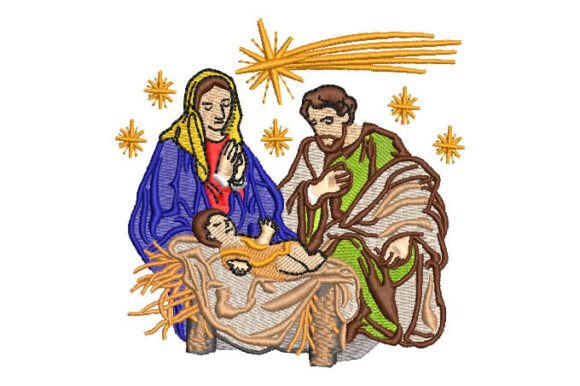
Review: Birth of Jesus in Bethlehem Embroidery
As an embroidery designer who has spent years digitizing files for small businesses, I approach every new machine embroidery design with a critical eye. It is not just about whether the image looks pretty on a screen; it is about how it performs under the needle, how it holds up after washing, and most importantly, how it serves the brand identity of the business using it. Recently, I evaluated the Birth of Jesus in Bethlehem Embroidery for potential use in commercial projects. This review focuses on its viability for small business merchandise, branded patches, and holiday-themed product lines.
First Impressions and Visual Personality
The initial appeal of the Birth of Jesus in Bethlehem Embroidery lies in its thematic resonance. For businesses operating within the Christmas season, this design offers a classic, reverent aesthetic. The description notes that it is professionally digitized and suitable for various fabrics, which suggests versatility. Visually, this type of design typically leans toward a traditional or rustic style, evoking feelings of warmth, heritage, and peace.
For a boutique owner or a handmade brand, this visual personality is crucial. It does not scream "modern minimalism"; instead, it communicates tradition. If your brand values include family, faith, or classic holiday cheer, this design aligns perfectly. However, if your brand is ultra-modern or edgy, this might feel out of place. The key is matching the design’s elegance with your existing design assets. When I look at this file, I see a piece that works best when treated with respect to its detailed nature, rather than being shrunk down to an insignificant size.
Real-World Applications for Small Business Merch
The true test of any digital embroidery file is its application in real-world scenarios. Here is how I envision the Birth of Jesus in Bethlehem Embroidery performing across different product categories for small business owners, Etsy sellers, and apparel decorators.
Embroidered Patches and Labels
One of the most profitable avenues for this design is the embroidered patch. Patches allow customers to add a personal touch to jackets, bags, or hats without committing to a full garment print. Because this design likely contains intricate details representing the nativity scene, it requires a sufficient hoop size to maintain clarity. A patch format allows you to control the backing and stability, ensuring the stitch density does not pucker the fabric. For a bakery or florist looking to create limited-edition holiday gifts, these patches can be sewn onto tote bags or aprons as a premium add-on.
Custom Apparel and Uniforms
For local boutiques or creative studios, custom apparel is a staple. This design works exceptionally well on heavier fabrics like denim jackets, canvas tote bags, or thick cotton hoodies. The texture of these materials supports the weight of the embroidery. Imagine a local café offering a limited-run holiday mug and a matching tote bag featuring this design. The Birth of Jesus in Bethlehem Embroidery becomes a badge of community and seasonality. However, for staff uniforms, caution is advised. If the design is too large or dense, it may become uncomfortable on a work shirt worn for eight hours a day. In such cases, consider using it as a sleeve detail or a back yoke accent rather than a chest logo.
Cap and Tote Bag Design
Cap embroidery is tricky due to the curved surface. This design should only be used on caps if it can be simplified or if the cap has a large, flat front panel. Otherwise, the distortion may ruin the recognizable elements of the scene. Conversely, tote bag design is an ideal match. The flat, sturdy surface of a canvas tote provides the perfect canvas for this intricate work. It transforms a simple bag into a keepsake item, increasing the perceived value of the handmade product.
Technical Considerations and Constraints
While the aesthetic is beautiful, technical execution is where many businesses fail. The description states the design works with any type of fabric, but as a professional, I must advise nuance. Here are critical areas where you must exercise care:
- Stitch Density and Fabric Texture: Detailed scenes often have high stitch counts. On lightweight or stretchy fabrics, this can cause puckering. Always use a cut-away stabilizer for garments that will be washed frequently. For woven fabrics like linen or canvas, a tear-away might suffice, but testing is mandatory.
- Small Patch Sizes: Do not attempt to shrink this design below its recommended minimum size. Fine details, such as facial features or small animals in the nativity scene, will merge into a blob of thread if scaled down too far. Check the recommended hoop size provided with the file and stick to it.
- Thread Colors and Contrast: The beauty of this design relies on color variation. Ensure you have a wide range of high-quality threads. Poor quality thread will fray and obscure details. Test the design in black and white first to ensure the contrast holds up even without color differentiation.
- Dark Uniforms: If embroidering on dark navy or black uniforms, you may need an underlay of white thread to make the colors pop. This adds bulk, so adjust your tension settings accordingly.
Impact on Brand Identity and Customer Trust
Using a high-quality Birth of Jesus in Bethlehem Embroidery does more than decorate a product; it enhances your brand identity. Consistency in quality signals professionalism. When a customer receives a finished product with clean stitches, proper tension, and no loose threads, their trust in your brand increases. This is particularly important for small business merch where competition is high.
Furthermore, this design can drive buyer engagement during the holiday season. It creates an emotional connection. Customers are not just buying a patch or a shirt; they are buying into a tradition. This emotional resonance can justify a higher price point, as the item is perceived as a premium, thoughtful gift rather than a generic commodity. For Etsy sellers, using this design in printable mockup images can significantly boost click-through rates, provided the mockups accurately represent the texture and depth of the actual embroidery.
Practical Designer Notes for Production
Before you launch this design into your commercial embroidery workflow, follow these steps to ensure success:
- Verify File Details: The product description mentions professional digitization but does not specify exact stitch count, file formats, or license terms. Always download the sample or check the vendor’s site for these specifics before purchase. Ensure the file format is compatible with your machine (e.g., PES, DST, JEF).
- Test on Real Fabric: Never skip the test stitch. Use the same fabric and stabilizer combination you plan to use for production. Check for registration issues where colors meet.
- Create a Mockup: Before selling, create a physical sample and photograph it. Use this image for your printable mockup listings. Customers need to see the scale and texture.
- Confirm Commercial Licensing: Ensure your purchase includes the right to use the design for sold goods. Some licenses restrict the number of items you can sell or require additional fees for mass production.
- Inspect Spacing: Look closely at the spacing between elements. If threads are too close, they may overlap and cause breakage. If too far, the fabric may show through awkwardly.
In conclusion, the Birth of Jesus in Bethlehem Embroidery is a strong candidate for businesses looking to add a touch of traditional holiday warmth to their offerings. It excels in patches, tote bags, and heavier apparel but requires careful technical handling to maintain its integrity. By respecting the design’s complexity and adhering to best practices in stabilization and thread selection, you can create high-value merchandise that enhances your brand and delights your customers. Always prioritize quality over quantity, and let the craftsmanship of the embroidery speak for your business.